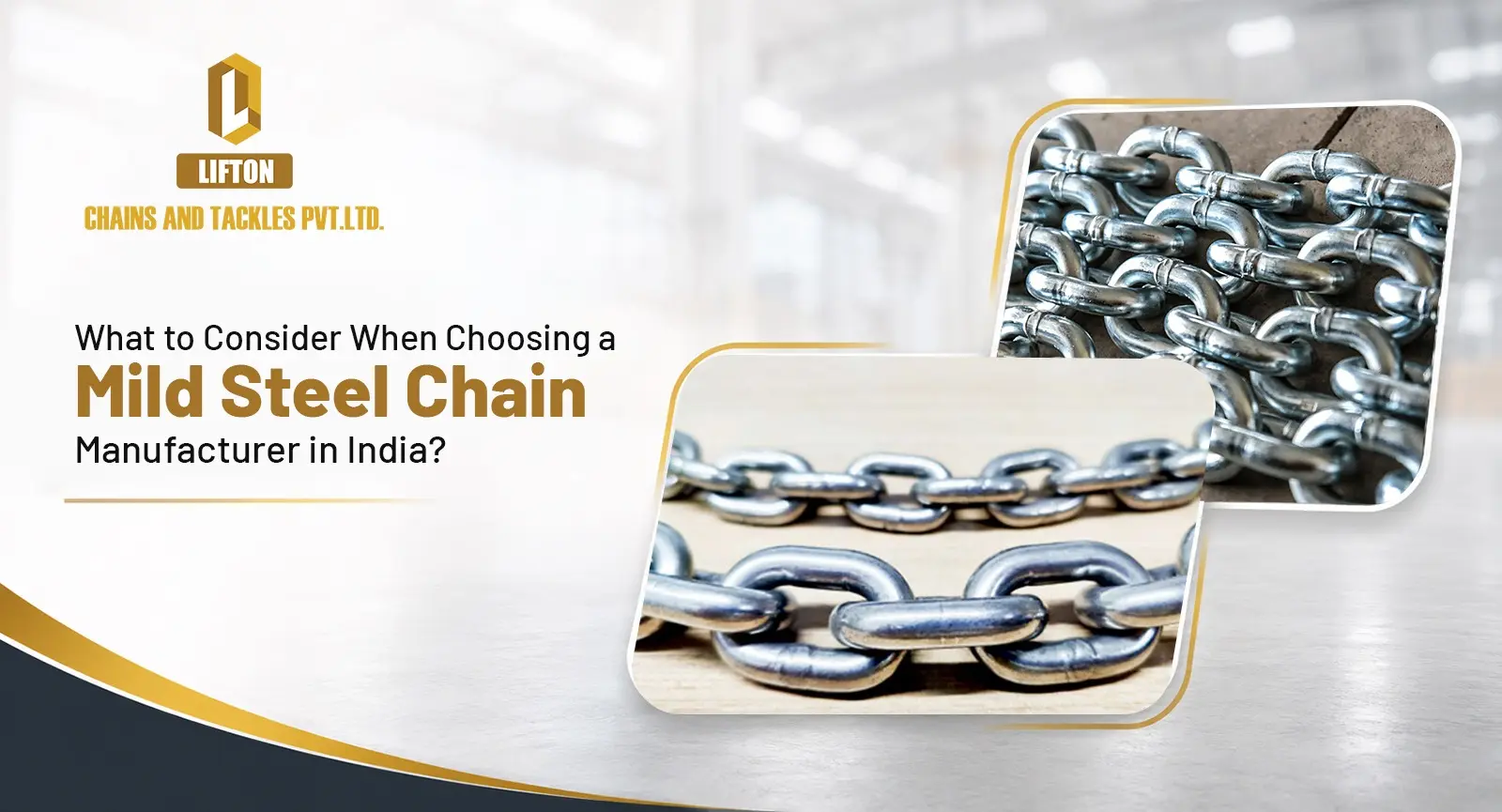
What to Consider When Choosing a Mild Steel Chain Manufacturer in India?

The Main Points
This guide explains what factors to check before you choose a manufacturer of mild steel chain, from material and size to strength rating, finish, testing and delivery. It also lists common buying mistakes and simple care tips.
Plan of This Guide
Why Choosing the Maker Needs Care
A chain looks simple, since it is only a series of linked loops of steel, but two chains of the same size can behave very differently. One may have clean, even welds and uniform links, while the other has weak welds and links of uneven size.
The difference shows up only when the chain is loaded, dragged or left outside through a monsoon, and by then it is already in use. A failure at that stage can stop work or hurt someone, which is why the maker matters as much as the price.
In India, chains also face rain, humidity, dust and rough handling. A chain that suits a covered workshop may rust within weeks in an open yard or near the coast, so think about where the chain will work before you ask for quotations.
What Mild Steel Chain Is and Where It Is Used
Mild steel chain is made from low-carbon steel, which means the steel holds a small share of carbon, typically between 0.05% and 0.25%. This makes it soft, ductile and easy to weld, and it costs less than alloy steel chain.
Grade 30 is a general-purpose chain grade, and its strength is lower than that of the alloy grades 70, 80 and 100, which are made for lifting.
Lifton Chains and Tackles lists these uses for its range: conveyor systems, fencing, agricultural machinery, marine and boating work, hardware and fasteners, suspension and hanging systems, and light hoisting equipment.
Most of these are general-purpose jobs where the chain pulls, hangs, drags or holds a load. Mild steel chain is usually not the first choice where very high strength is needed for overhead lifting, and for that work buyers normally choose alloy steel chain, such as Grade 80 or Grade 100, which is made and tested for lifting.
Eight Things to Check Before You Buy
- Material. Ask for the steel grade and the raw material test certificate, which a maker who buys steel from reputed vendors and keeps its records can show you. Without this record, you cannot tell what the chain is made of.
- Size and pitch. Chain size is the diameter of the steel bar in each link, measured in millimetres, and pitch is the distance from the centre of one link to the centre of the next. Lifton lists Grade 30 mild steel chain from 3 mm to 16 mm diameter, with a pitch for each size, so check that the size and pitch match your sprocket, hook or fitting.
- Grade and rated load. Grade 30 is the grade listed for this range. Ask for the working load limit, which is the highest load the chain should carry in normal use, and do not guess the strength from the size alone.
- Weld and link quality. Look at the welds on sample links, which should be clean and even, and check that the links are uniform in size and free of cracks. Welds are where chain failures often begin, so this check is worth the time.
- Surface finish. Plain mild steel chain can rust, while a galvanised finish, which is a zinc coating, protects against it. Lifton lists a separate galvanised range, and you should choose the finish by where the chain will work, such as outdoors, near the coast or in damp areas.
- Inspection and testing. The company states that it inspects each item and has a quality testing unit. Ask what tests are carried out and whether you receive a record, because a test record shows the chain was checked and not only made.
- Customisation. Check whether the maker can cut the chain to your length and supply end fittings. Lifton lists custom chain lengths.
- Delivery and stock. Ask about stock and delivery time, since a maker with a stocked warehouse can usually deliver common sizes faster. Get the delivery date in writing, because a late delivery can stop your own production.
How to Compare Quotations
Ask each maker to quote the same thing by stating the diameter, pitch, grade, finish, length and quantity. Then compare the offers line by line: price per metre or per piece, grade, finish, test certificate, delivery date, payment terms and what happens if a lot is rejected.
Ask for a sample piece before a large order, and check its weld and finish yourself. A sample costs little compared with a rejected lot.
Mistakes Buyers Make
Using mild steel chain for overhead lifting without checking. Confirm the rated load and whether the chain is made and tested for lifting, and if it is not, use an alloy steel chain.
Choosing by price per metre. A cheaper chain with weak welds costs more when it fails.
Ignoring the size and pitch. A chain with the wrong pitch will not run properly on a sprocket.
Not asking about welds. The weld is the weakest point of a link, so ask how it is made and checked.
Forgetting the environment. Plain steel in a damp or coastal area rusts quickly, so choose galvanised or stainless steel if the conditions need it.
Skipping documents. Keep the test certificate and the invoice with the chain for your records.
Handling and Care
Store dry. Keep the chain off the floor in a dry place, because rust forms fast on bare steel during the monsoon.
Keep it clean. Wipe off mud, dust and moisture after use.
Lubricate. A light oil film protects the links and helps them move smoothly.
Inspect before use. Check each link for stretch, bends, cracks and wear, and replace a damaged chain.
Avoid sharp edges. Do not drag the chain over sharp corners, which can nick the links.
Do not overload. Stay inside the rated load and avoid sudden jerks.
Start With Your Requirement
Before you contact any maker, answer two questions: what will the chain do, and how long a piece do you need, with what fittings?
Lifton Chains and Tackles Pvt. Ltd. was established in 2020 and works from Taloja, Navi Mumbai, in Maharashtra, making mild steel, stainless steel and alloy steel chains for material handling. Tell the team how you will use the chain, the size you need and the quantity, and a rough description of the job helps them suggest a suitable size and finish.